

Usually, people walk into a conversation ready to explain.
The ones who convert walk in ready to listen.
There's a version of your content that pushes. And a version that makes people lean in. The difference is in how the message is framed.
Here's what's in this week's edition:
🪝 Steal The Hook — The one that trades postcard marketing for lived reality
🧠 Follow The Leader — Who makes the prospect say it first
🏆 And the Oscar Goes To… — Earn trust by getting more specific, not less
Let's get into it.
Steal The Hook
The Anti-Pitch
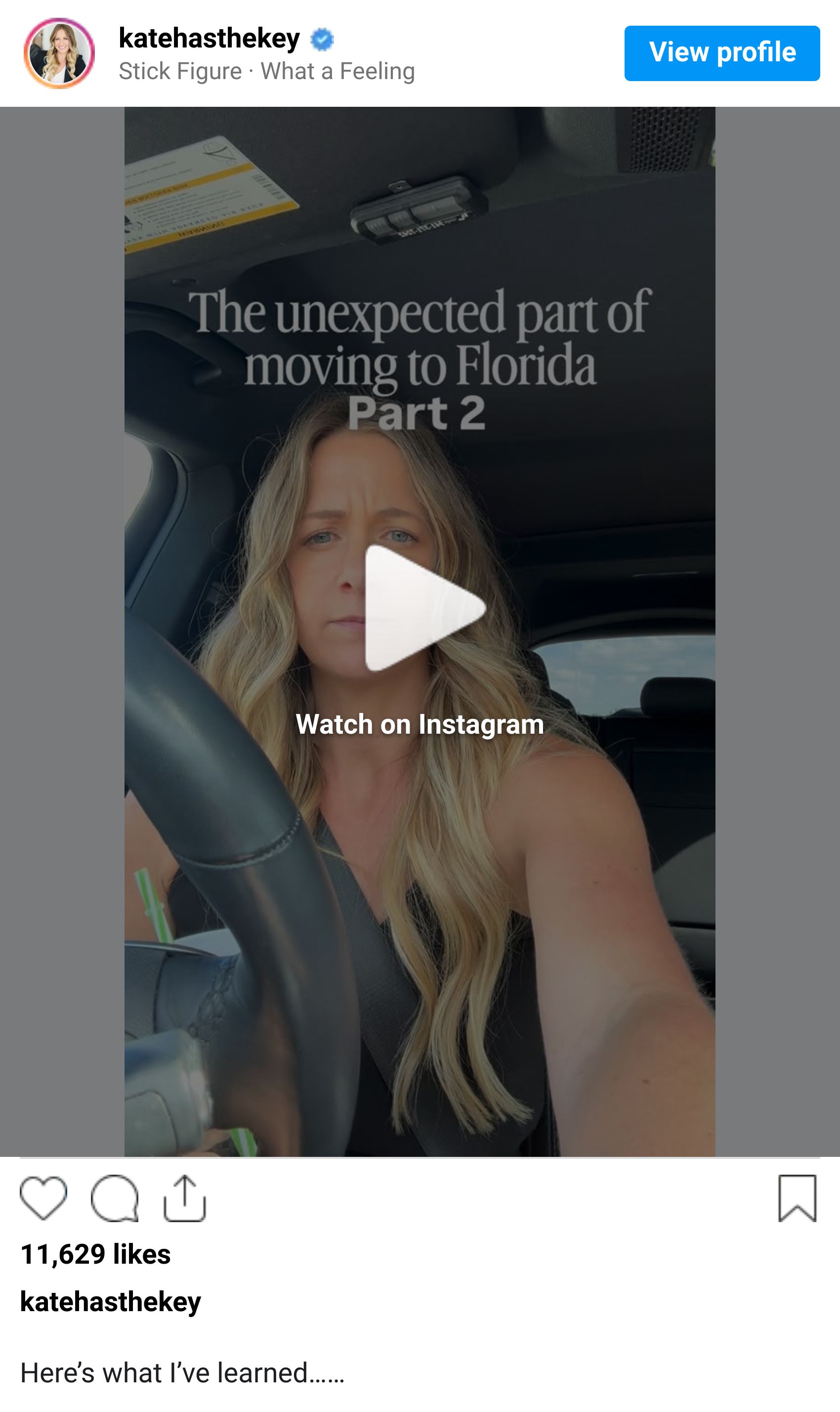
No drone shots. No beach montage. No “live where everyone vacations” angle.
That line works because it doesn’t ask the audience to learn anything yet. Instead, it asks them to re-enter a place they already know.
She takes the most obvious assumptions people have about Florida and deflates them.
This is one of the highest-leverage moves in relocation content.
A lot of relocation content tries to raise desire.
But if you want to build trust early and often in your content, try this approach instead.
Here’s what we mean:
Instead of:
“Living in Charlotte is amazing.”
Try:
“The part of moving to Charlotte most buyers don’t think about until they’re here.”
Instead of:
“Why everyone wants to live in Denver.”
Try:
“The unexpected part of living in Denver once the first winter hits.”
The hook's job isn't to make your market sound better.
It's to make your market sound real. Agents who do this don't have to sell the lifestyle. The content does it for them.
Follow The Leader
Jeremy Lee Miner (Founder of 7th Level)

If you want to know what to say without sounding like you’re selling, study Jeremy Lee Miner.
He’s the founder of 7th Level, has built a massive audience around modern sales training, and created NEPQ - a methodology built on one idea: people are more likely to trust what they arrive at on their own than what gets pushed on them.
One part of his teaching stands out: He doesn’t just change the question. He changes the pattern.
Most sales questions are too easy to read.
Why are you selling?
What challenges are you having?
What would you change?
There’s nothing wrong with those questions. The problem is that people can feel where they’re leading.
And once they feel that, their guard goes up.
Jeremy’s move is to change the shape of the question before he changes the content of it.
He uses this real estate example:
Instead of:
“Why do you want to sell your home?”
He suggests:
“What’s caused you to feel like you might want to sell?”
The question feels less interrogative. Less loaded. Less like it’s trying to pull someone toward a conclusion.
So the seller lowers their guard, and starts to open up.
“We need more space” might mean another baby is coming.
“We’re thinking about downsizing” might mean cash flow is tighter than they want to admit.
“We may want to make a move” might mean the timeline is already shorter than they’re saying.
The Takeaway
A better question gets you to the truth faster.
Not every good sales question is direct.
Some of the best ones work because they don’t sound like the question the prospect was preparing for.
Want to watch him break this down? Start at 12:35-that’s where he shows how most agents ask the wrong question, then rewrites it to lower resistance and get the seller talking.
And the Oscar Goes To…
The market video that gets more useful by getting more specific

That line does two things at once.
It creates tension, and it immediately narrows the conversation.
This is no longer a broad market update about San Diego. It’s a breakdown of where demand is softening, why it’s happening, and what kind of buyer or seller is most exposed to it.

The Structure That Does the Work
What this creator does really well is move from trend to framework. He doesn’t stay at the level of “the market is shifting.”
He breaks the shift into categories buyers and sellers can actually use: affordability ceilings, commute tradeoffs, school district comparisons, housing age, buyer-pool sensitivity, and lifestyle versus payment.
As each neighborhood comes up, the viewer is given a reason that explains why that area is cooling before being told who may be leaving and where they may go instead.
A lot of agents stop at observation. This video keeps going until the audience has a way to sort what they’re seeing. That makes the content more useful than a typical “here’s what’s happening in the market” video, because the viewer can start placing their own situation inside the framework as it unfolds.
What You Can Steal
If you’re making market content, don’t just report the shift. Break it down into the forces behind the shift.
Instead of: “This area is cooling.”
Try: “This area is cooling because the price point outran local income, the homes need updating, and buyers now have stronger alternatives nearby.”
Or instead of: “Buyers are moving outward.”
Try: “Buyers are trading coast for payment, walkability for square footage, and older housing stock for newer inventory.”
Now the content has shape. Now the audience has something to compare against.
Copy/paste title formula
[City] Neighborhoods Everyone is LEAVING in [Year]
Where Buyers Are Pulling Back in [City] — And What They’re Choosing Instead
[City] Neighborhoods People Are Starting to Leave — Here’s Why
What Buyers No Longer Want to Pay For in [City]
The Real Takeaway
A strong market video doesn’t just surface a change, it organizes it. It interprets it.
That’s what makes it valuable.
The viewer leaves with a clearer way to read the market, not just a stronger opinion about it.
The best marketing reads the room.
It knows when to replace the fantasy with something more realistic.
How to ask questions that compel people to open up.
When to interpret a shift in the market instead of just surfacing it.
We’ll see you next week.
P.S. Want to go even deeper on the strategies behind what works? Head over to ListingLeads.com, new resources drop every week for agents who want an edge.