

A lot of content problems are really strategy problems.
It isn't the editing. It isn't the market being crowded. It's that the idea underneath the content was never strong enough to carry it.
That's what this week is about.
Creative strategy decides whether a video gets watched, skipped, saved, or scrolled past. It shows up in the angle, the format, and the first 3 seconds. It's the choice to make the message feel native to the platform instead of forced onto it.
3 examples that get it right:
Here's what's in this week's edition:
🪝 Steal The Hook — a human-first way into the listing
🧠 Follow The Leader — how to stop creating from scratch
🏆 And the Oscar Goes To… — the one who lets the locals do the selling
Let's get into it.
Steal The Hook
The Misdirection Play
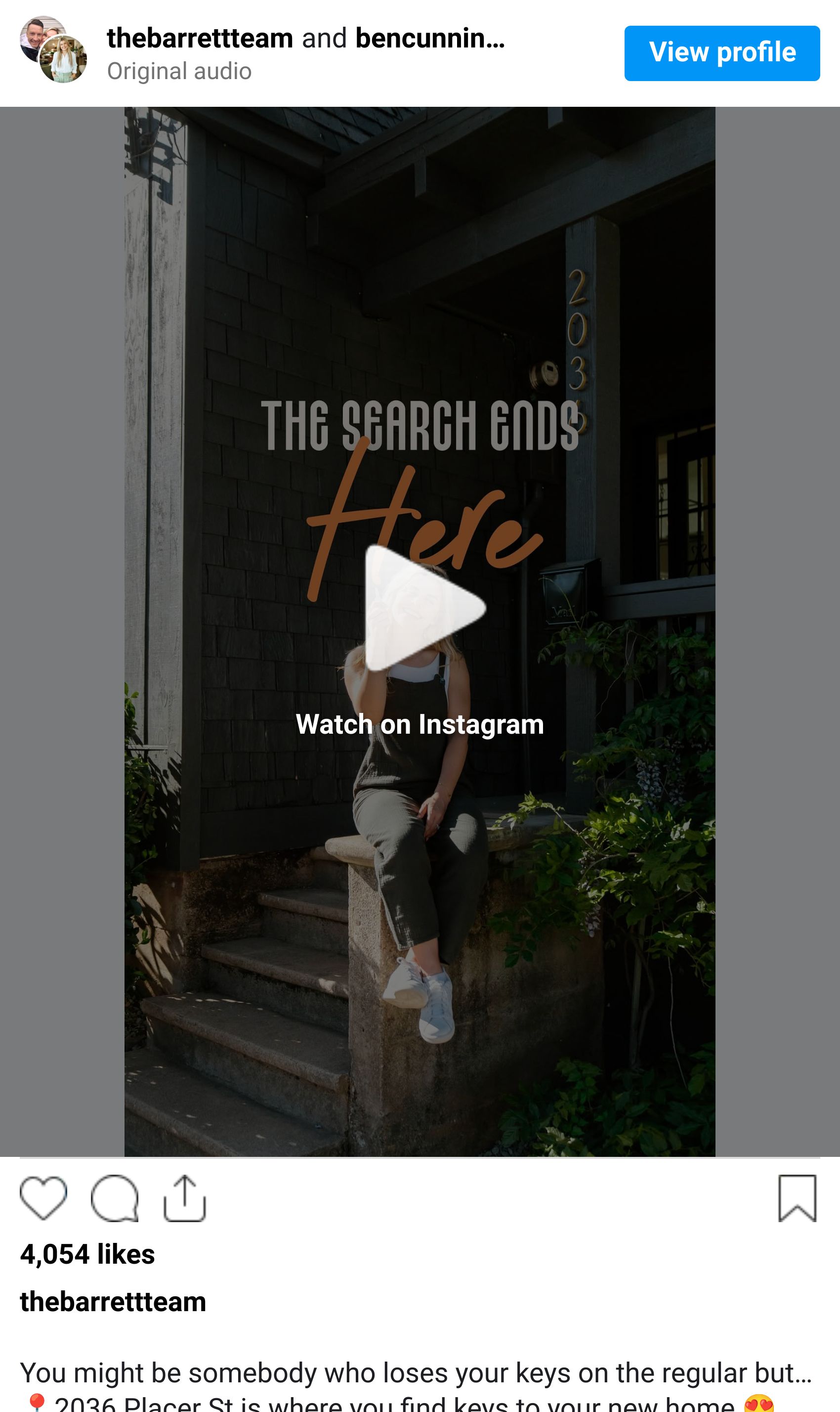
That opening buys attention before the listing ever asks for it. You understand the situation instantly: missing keys, mild panic, a quick self-roast. Then while she's checking the bathroom, the living room, upstairs, and the front door, the house keeps revealing itself. Kitchen, layout, backyard, flow. By the time the viewer realizes what's happening, they're already in the tour.
What's actually happening
The hook borrows attention from a familiar moment. The listing is there the whole time, but it enters through something more relatable than square footage or finishes. The video earns the first few seconds with behavior, not information. Then the house takes over.
A home tour asks for interest up front. A missing-keys moment earns it first.
Why it works
A standard listing video asks the viewer to care about a house on sight. This one doesn't. It gives them a situation they already recognize and lets them step into it before the pitch lands.
What you can steal
Every listing has a more human way in.
Instead of: "Come tour this beautiful 4-bedroom home."
Try: "I was two steps from leaving when I realized I forgot the one thing I actually needed."
Or: "This was supposed to be a quick stop back inside."
The real takeaway
The hook isn't the house. It's the moment around the house.
Build that first. The tour will carry itself.
Follow The Leader
Dara Denney

If you want to level up your creative strategy, study Dara Denney.
One reason her content is so useful: she treats creative like something you can source, test, and improve, not just invent from scratch.
In a recent post, she talks about “ethically stealing” viral TikToks. Not ripping them off. Finding content that's already proven it can hold attention, getting permission to use it, and building on something validated instead of guessing.
P.T. Barnum (known as the 'Great American Showman'), said it 150 years ago: "Nothing draws a crowd like a crowd."
Attention follows attention.
A format that's already working is doing half the job for you.
You don't need to invent every listing video, market update, or buyer Reel from scratch. You need a better eye for the patterns that already work.
A hook that earns the first 3 seconds.
A format that feels native to the platform.
A structure that holds attention long enough for the point to land.
Then adapt. Take the structure of a strong video and apply it to a listing, a neighborhood, or a buyer pain point.
That's a smarter starting line than a blank page.
And the Oscar Goes To…
What happens when you pass the mic

That’s a much stronger setup than a standard relocation opener.
This is no longer a relocation pitch.
It’s a decision-making tool.

The Structure That Does the Work
What makes this video worth studying is the format choice.
The creator doesn’t open by explaining Orange County. Instead, they hand the mic to people living there.
Now the viewer gets the upside and the friction in the same video: safety, cleanliness, weather, parks, beaches, and central location, alongside cost of living, traffic, car dependence, parking, nightlife, and the fact that Orange County changes block by block.
Then they do something even smarter.
They come back in and organize what they heard.
They separate county-wide truths from micro-market truths. They point out that diversity, weather, traffic, and even lifestyle vary by location, and they use that nuance to move the viewer from a vague opinion to better judgment.
The format earns trust first, and then the interpretation makes it useful.
What You Can Steal
If you are making relocation or neighborhood content, do not assume the strongest move is talking more.
Sometimes the better move is designing a format that makes the market easier to evaluate.
Instead of:
“Why you should move to [City].”
Try:
“We asked locals what living in [City] is actually like.”
Or instead of:
“The pros and cons of living in [Neighborhood].”
Try:
“If you moved here tomorrow, what would surprise you most?”
Copy/paste title formula
We Asked Locals What Living in [City] Is Actually Like
More options that fit the same pattern:
What People Love and Hate About Living in [City]
Before You Move to [City], Hear This First
The Honest Version of Living in [City], According to Locals
The Real Takeaway
A strong format does more than hold attention.
It changes how the viewer processes the message.
The interviews create trust. The follow-up interpretation turns that trust into something useful.
Creative strategy shows up long before the camera turns on.
In the hook you choose.
In the format you borrow.
In the decision to let the right voice carry the message.
That’s where stronger content starts.
—The ListingLeads Team
P.S. Want frameworks like these applied directly to your listings and your market? Join ListingLeads.com, where we drop new resources every week for agents who want an edge.